Stephen J. Hucker, MB, BS, FRCP(C), FRCPsych
  Consultant Psychiatrist,
  Professor, Division of Forensic Psychiatry, University of Toronto

       Forensic Psychiatry. ca

Psychiatric Aspects of Risk Assessment
Overview
Prevalence of Violent Behaviour in Relation to Mental Disorder
Predictive Factors for Future Violence
Risk Assessment Instruments
Risk Assessment & Management: Significant Research & Literatur
e


Overview

“How dangerous is it that this man go loose?” Shakespeare asked in Hamlet. This is a question to which the courts, lawyers, mental health professionals and the general public all want to know the answer.

As late as the 1960's there were few scientific data upon which to make decisions about the release of mentally disordered individuals who had committed crimes. This has changed in recent years. Dr. John Monahan in his1981 book Predicting Dangerousness: An Assessment of Clinical Techniques summarized the limited knowledge available at the time and set in motion a program of research that has yielded the much needed information in many jurisdictions.

The research over the past two decades has produced a number of actuarial measures that can be used in the assessment of risk. Combined with clinical assessment, these actuarial instruments have markedly improved the ability of forensic mental health professionals to assess not only the likelihood that a violent act will occur but specify but the type of risk associated with various populations.


Prevalence of Violent Behaviour in Relation to Mental Disorder

It is well known that prisons contain substantial numbers of individuals with psychiatric disorders, substance abuse problems, and personality disorders. Research has shown that the rates of severe mental illness for incarcerated populations are 3-4 times higher than those of the general population. It has also indicated that substance abuse and personality disorders can range from 5 - 20% higher in incarcerated populations.


Factors Predictive of Future Violence

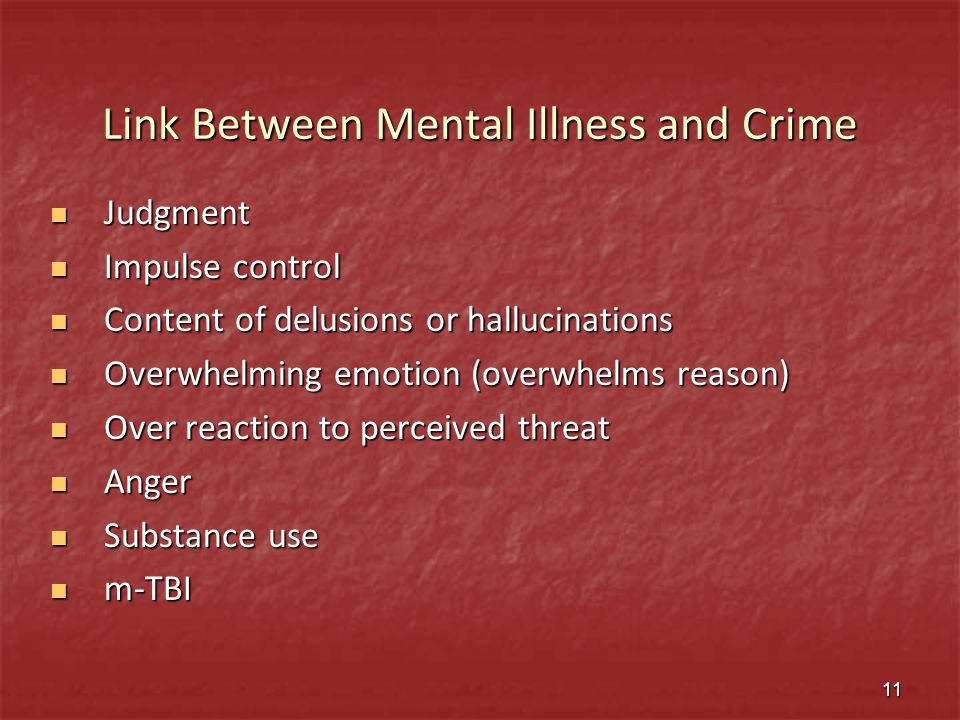
Actuarial instruments as well as clinical assessments consider a number of factors in their assessment of risk potential magnitude, imminence and frequency. Research has indicated that the following factors have predictive value:

1. Base Rates

  • refers to the frequency of violence in a given population
  • one of the most highly predictive actuarial factors
  • does not relate specifically to mental disorder
  • can "over-predict" (eg. can incorrectly identify some offenders as potential killers)

2. Demographic Factors Associated with Increased Risk

  • men more highly represented in criminal and violent populations (though not necessarily in psychiatric areas)
  • age: crime (especially violent) tends to occur more in younger than in older men
  • unemployment: low socioeconomic status, low educational achievement correlate with violence
  • race and ethnicity: although these can be factors, they tend to dissipate when the other factors taken into account statistically

3. Past History of Violence

  • violent history: one of most powerful indicators of future violence potential
  • nature of the violence: always important to consider(eg. types of victims, environmental and contextual issues, etc)

4. Substance Abuse

  • drugs and alcohol are major contributors to violence amongst both mentally disordered and non-mentally disordered offenders
  • prevalence of substance abuse in mentally disordered offender tends to be higher than in general (non-incarcerated) population
  • substance abuse is important risk factor in psychotic individuals
  • doubles the lifetime risk of violence among the severely mentally disordered, particularly if substance abuse had early onset

5. Psychiatric Diagnosis and Risk of Violence

  • earlier research linked violence with schizophrenic patients in particular but later studies have been more equivocal about this
  • however, recent meta-analyses suggest that risk of violence is three-fold among those with psychosis
  • much more relevant to look at psychiatric symptoms as opposed to diagnosis:

6. Acute Psychiatric Symptoms:

a) Mania (and Violence):
- mania is form of serious mental illness
- characterized by elevated mood or irritability, sense of grandiosity &/or invincibility, racing thoughts and speech patterns
- can result in threatening and assaultive behaviour but serious intentional violence is rare

b) Depression (and Violence):
- characteristics of major depression include feelings of worthlessness or inappropriate guilt, indecisiveness, lack of concentration, loss or gain of weight & appetite, persistently depressed mood, persistent need for more sleep, loss of energy and general fatigue, persistent lack of interest and pleasure in activities, sometimes there are thoughts of death or suicide
- violence can be either self-directed (suicide) or directed to others, usually those close to the individual
- examples: depressed mothers who kill their children; depressed men who kill family members and then themselves

c) Delusions (and violence):
- fixed false beliefs that cannot be reasoned away, usually out of keeping with the individual's educational, social and cultural background
- research indicates consistent links between violent behavior and delusions
- particularly noteworthy are delusions of being threatened by others, paranoid delusions of personal control being overridden
- delusions can be categorized into main sub-sets:

Delusional Misidentification Syndrome:
- an unusual and rare group of psychotic disorders
- individual has delusion of being an imposter, "not who they say they are"
- in association with delusional ideas, these individuals often have strongly paranoid ideas and intense hostility
- can be dangerous when they mi s-identify themselves as powerful religious figures
Stalkers:
-a behavioural phenomenon as opposed to a diagnosis
- many typologies of stalkers:

  • Erotomania: Individual believes that someone outside their normal sphere of interaction (eg. television personality) is in love with them and is sending them coded messages supporting and encouraging a relationship
  • Erotomania & Violence: Erotomaniacs are more often male than female. Fewer than 5% are violent . The person who gets in the way is the most likely to be injured, followed by the person who is the "love object"
  • Pathological Love: Different from erotomania in that the individual perceives the unattainable person as the "best person for me, if only I could meet her." Individual tends to follow the object of their affection, hoping for glimpses or chance meetings.
  • Pathological Jealousy: Exhibited by individuals who cannot accept rejection. Attitude of "if I can't have you, no one will".
  • Paraphiliacs: Individuals with sexual deviations who become particularly fixated on particular targets.
  • Stalkers who Kill Strangers: These individuals tend to be more often mentally disordered than otherwise. Believe themselves to be unique, tend to identify with other stalkers, collect newspaper clippings, etc. They research their target victims thoroughly. Often fanatical about keeping records, diaries, photographs of their stalking activities. May even purchase a weapon for the particular "mission" they are on. Targets of their attentions can change.

d) Hallucinations (and violence)
- false perceptions (eg. hearing things that are not there)
Command Hallucinations:
- a hallucination/voice that tells someone to do something
- studies indicate that individuals hearing command hallucinations act on them about 40% of the time but studies have not been well controlled
- risk of violence stemming from a command hallucination is increased if the "voice" is familiar (eg. mother)


Violent Fantasies:
-
approximately 70% of males in general population have had violent fantasies or homicidal thoughts at one time or another
- persistent violent thoughts are associated with violence in patients with severe substance abuse but no mental disorder (ie. people other than the acutely psychotic are most worrisome)
- reporting of violent thoughts associated with diagnosis of psychopathy

7. Antisocial Personality Disorders

  • characterized by persistent disregard for and violation of the rights of others
  • begins in childhood
  • higher prevalence of it in severely mentally ill population and in prison population (50-70%)
  • strong association with substance abuse
  • strong predictor of criminal recidivism, particularly violent recidivism, and especially in women

8. Psychopathy

  • often overlaps with Antisocial Personality Disorder (APD)
  • characterized by combination of traits from APD and Narcissistic Personality Disorder: self-centredness, egocentricity, lack of empathy, etc.
  • treatment of psychopathy problematic and research has shown can be counterproductive (Penetanguishene MHC)
  • degree of psychopathy measured effectively by Hare's Psychopathy Checklist-Revised (PCL-R)
  • high scores on PCL-R consistently correlate with violence in incarcerated offenders and forensic patients
  • PCL-R score incorporated as key feature in the Violence Risk Assessment Guide (VRAG) which assesses violence risk potential

9. Organic Disorders and Learning Disorders (influence of)

  • presence increases the risk of violence
  • elderly neurologically impaired responsible for disproportionately high number of violent incidents in health care facilities
  • PMS (and violence):
    - associated with violence of women against spouses (women who kill spouses are more often in the first five days of their cycle)
  • Epilepsy and violence:
    - a neurological disease rather than a psychiatric disorder
    - violence can be unintentional as result of seizures
    - when violence occurs in intericatal period (between seizures), is often associated with temporal lobe epilepsy
  • Attention Deficit/Hyperactivity Disorder ( ADHD):
    - persistent patter of inattention or hyperactivity-impulsivity
    - in childhood, is more frequent and severe than comparable behavior of other children at similar stages of development
    - child and adult versions
    - strongly associated with childhood aggression and later conduct disorder
    - presence in childhood increases risk of early onset criminality

10. Biological Aspects (influence of):

  • frontal lobe deficits
  • neurotransmitter abnormalities
  • perinatal neurological damage
  • behavioural genetics

11. Attachment, Mental Disorder and Criminality

  • children learn about relationships through complex interruption with their caregivers
  • early disruption of this attachment can lead to later psychopathology, mental disorders and criminality in some individuals
  • fertile ground for research into relationship between abuse/neglect and later violence:
  • it may well be that prison environments tend to replicate or reflect lack of care that some offenders may have experienced as children

12. Adverse Childhood Experiences, Mental Disorder and Violence

  • some studies of offenders and non-offenders with severe mental disorder have shown similar background factors that increase risk of adult violence when compared with non-mentally disordered individuals
  • research in the area is often methodologically flawed due to lack of control groups, prospective studies. There is need for more controlled research in this area
  • Conduct Disorder: can be either early or later onset
    - early onset tends not to remit and is associated with later violent and non-violent offending
    - late onset conduct disorder tends to subside
    - can be considered a larval form of antisocial personality disorder
    - characterized by persistent and repetitive patterns of behavior which involves violations of rights of others and age-appropriate social norms
    - often seen in boys with neurodevelopmental delays
    - correlation seen with socioeconomic standing
    - family characteristics of conduct disorder can include abuse,parental neglect, personality disorder, or alcoholism
    - research indicates that the more severe and wide-ranging the symptoms in childhood, the stronger the likelihood of adult violent behaviour
  • Peer Attachment and Social Functioning:
    - maltreated children often begin early to relate inappropriately to people (eg. may respond with anger or aggression to friendly gesture from peers or signs of distress from them)
    - can display deficiencies in social competence, immature thinking
    - can be in attentive to social cues in interpersonal situations
    - can be inclined to attribute hostile intentions to others

References and Further Reading

Rettenberger, M. & Hucker, S.J. (2011) “Structured professional guidelines: International applications”, Chapter 5, pp 85-110. In: International Perspectives on Sex Offender Assessment & Treatment: Theory, Practice and Research. (Eds) Boer, D., Eher, R., Craig, L., Miner M., & Pfaefflin, F. Wiley: London

Rettenberger, M., Hucker, S.J., Boer, D.P., Eher, R. (2009) The Reliability and Validity of the Sexual Violence Risk-20: An International Review. Sexual Offender Treatment, Volume 4, Issue 2, 1-14.

Hucker, S.J. (2008) “Psychiatric aspects of risk assessment.” Chapter 5 in: Risk Assessment & Risk management: A Canadian Criminal Justice Perspective. Ping, W. & Chang, V.C. (eds). International Centre for Criminal Law Reform & Criminal Justice Policy.

Webster, C.D. & Hucker, S.J., Violence Risk: Assessment & Management (2nd edition). 2007 Wiley: London --- 3rd edition forthcoming 2011

Bloom, H, Webster, C.D., Hucker, S.J. & DeFreitas, K. “The Canadian Contribution to Violence Risk Assessment: History and Implications for Current Psychiatric Practice” Canadian Journal of Psychiatry (2005), 50(1), 3-11.

Webster, C.D. & Hucker, S.J., Release Decision-Making (2003), St. Joseph’s Healthcare: Hamilton, ON.

Webster, C.D., Hucker, S.J. & Bloom, H. “Transcending the Actuarial versus Clinical Polemic in Assessing Risk for Violence.” Criminal Justice & Behaviour (2002) 29/5, 659-665).

Serin R, Mailloux D. & Hucker S.J. (2001) “The Utility of Clinical and Actuarial Assessments of Offenders in Pre-release Psychiatric Decision-Making.” Forum on Corrections Research13/2, 36.

Webster, C. D., Ben‑Aron, M. H., & Hucker, S. J. (Eds.). (1985). Dangerousness: Probability, Prediction, Psychiatry and Public Policy. New York: Cambridge University Press.


© Stephen Hucker, MB,BS, FRCP(C), FRCPsych 2003 - 2011
This material is provided for personal use only. Any other use is strictly forbidden without the express written permission of the author


Contact Us    |     Disclaimer    |    ©2005-2012 ForensicPsychiatry.ca